
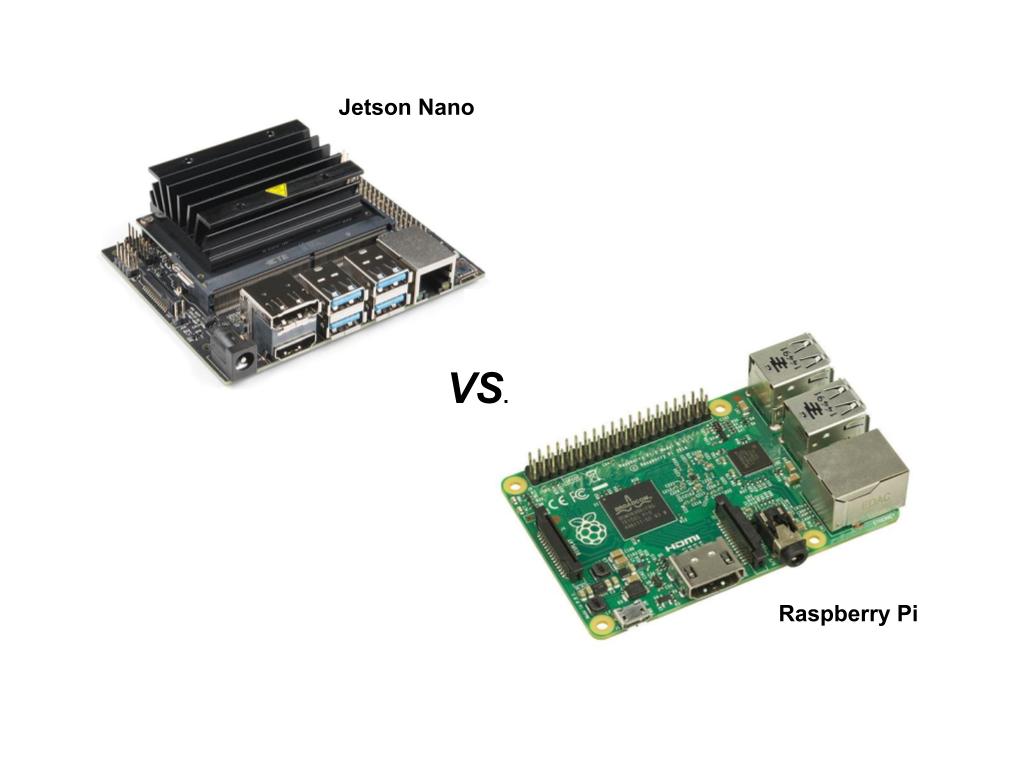
Single-board computers are a cheap way to build real things, and two names come up whenever AI or IoT is involved: NVIDIA Jetson and Raspberry Pi. They look alike on the desk, but they’re built for different jobs, and both lineups have changed a lot since this comparison first went up in 2023.
2026 Update: NVIDIA ended the Jetson Nano Developer Kit in 2024, and the module is only available through January 2027, so it’s no longer the board to start a new project on. Its successor, the Jetson Orin Nano , delivers up to 67 TOPS of AI performance in Super mode, far more than the original Nano could manage. On the Raspberry Pi side, the Raspberry Pi 5 (released October 2023) is the current flagship and easy to find.
The original Jetson Nano still gets plenty of searches, so its full guide is further down for anyone who has one in the field. If you’re buying new, keep reading.
TL;DR
- Building a general-purpose IoT device, learning to code, or prototyping without heavy AI? Get the Raspberry Pi 5.
- Need real-time computer vision, object detection, or a small local LLM on a budget? Start with the Jetson Orin Nano Super.
- Running several camera feeds or more than one model at once? Look at the Jetson Orin NX.
- Building a production robot or a multi-model AI pipeline? The Jetson AGX Orin is made for that.
- Working on humanoid robots or very large perception models? That’s Jetson AGX Thor territory.
- Already have a Jetson Nano? It still works. Jump to the Jetson Nano section
If none of that sounds like your project, save the money and buy the Pi. The sections below cover specs, current prices, and a head-to-head comparison.
What is Nvidia Jetson Orin?
NVIDIA Jetson Orin is NVIDIA’s current family of small, power-efficient computers for running AI at the edge, meaning on the device itself instead of in the cloud.
The basics:
- Runs AI on the device. Computer vision, object detection, even small language models, with no round trip to the cloud.
- Built on CUDA. It uses the same GPU software stack NVIDIA uses in its data centers, scaled down for embedded boards.
- Replaces the Jetson Nano. It’s far more capable, and NVIDIA now recommends it for any new AI or robotics project.
- A family, not one board. Prices run from a $399 entry-level dev kit to boards built for production robots.
Think of the lineup as a ladder. You pick the step that matches how much AI horsepower your project needs.
The Modern Jetson Lineup at a Glance
NVIDIA’s Jetson family today spans four active tiers, and each one is aimed at a different scale of AI workload. It helps to think of them less as “better vs. worse” and more as a ladder you climb depending on how much compute your project actually needs.
| Module | AI Performance | Power Envelope | Best For | Dev Kit Price (2026) |
|---|---|---|---|---|
| Jetson Orin Nano (4GB / 8GB Super) | Up to 34 to 67 TOPS | 7 to 25W (MAXN Super uncapped) | Entry-level edge AI, single-model inference, hobbyist and student builds | Around $399 (Super Dev Kit) |
| Jetson Orin NX (8GB / 16GB) | Up to 117 to 157 TOPS (Super Mode) | 10 to 40W | Multi-camera pipelines, parallel model inference, industrial vision | Around $599 and up (module-based) |
| Jetson AGX Orin (32GB / 64GB) | Up to 200 to 275 TOPS | 15 to 60W | Production robots, multi-model AI, autonomous machines |
Heads up on pricing: NVIDIA raised Jetson prices across the board in July 2026 without a public announcement, by as much as 101% on some modules. The Orin Nano Super Developer Kit, for example, went from $249 to $399. If an older article or store listing shows lower prices, it’s out of date.
A newer entry-level board is on the way, too. NVIDIA announced the Jetson Orin Nano 2 on August 25, 2026, with 78 TOPS, 8GB of RAM, and about 40% better power efficiency than the Orin Nano Super. Developer kits are expected in the first half of 2027.
Once you’ve picked a board, you’ll want to reach it remotely. Our guide to remotely accessing NVIDIA Jetson Orin covers the setup, and our guide to SSH into any NVIDIA Jetson behind CGNAT or a firewal works for the Orin Nano, Orin NX, and AGX Orin, with no static IP or port forwarding.
Your Jetson or Pi Fleet Growing Fast?
No static IPs, no port forwarding, no manual tracking. Just remote SSH access that scales with you.
What is Raspberry Pi?
Raspberry Pi is a low-cost, credit-card-sized computer designed in the UK. It runs Linux, so you can use it like a small desktop for browsing, coding, and everyday office work, or connect it to sensors, cameras, and motors for hobby and IoT projects.
It comes in several models. These are the three you’ll run into most often.
Raspberry Pi 5 (current generation, released October 2023)
The Raspberry Pi 5 is the best-known single-board computer for good reason: it’s fast for its size, affordable, and backed by the biggest community around.
Key specs:
- 2.4GHz quad-core Arm Cortex-A76 CPU and VideoCore VII GPU
- 1GB to 16GB of RAM
- Dual 4Kp60 HDMI output
- PCIe 2.0 for NVMe storage
- Wi-Fi 5, Bluetooth 5.0, USB 3.0, and Gigabit Ethernet
The Pi 5 can handle light AI inference on its CPU with frameworks like TensorFlow Lite and ONNX Runtime.
For heavier jobs, add an accelerator:
- AI HAT+: 13 TOPS (Hailo-8L) or 26 TOPS (Hailo-8)
- AI HAT+ 2: up to 40 TOPS with its own 8GB of dedicated RAM (Hailo-10H), launched in January 2026
A Pi 5 with the AI HAT+ 2 can get close to an entry-level Jetson on narrow, well-defined tasks, while staying cheaper and more flexible. And whichever Pi you choose, remote access and device management works the same way, with no port forwarding or static IP.
Raspberry Pi 4 Model B
The previous flagship is still widely deployed and still a solid choice for lighter workloads:
- 1.5GHz quad-core Arm Cortex-A72 CPU
- 2GB, 4GB, or 8GB RAM options
- Dual-band 2.4GHz and 5GHz Wi-Fi, Bluetooth 5.0/BLE
- Gigabit Ethernet, two USB 3.0 and two USB 2.0 ports
- Dual monitor support (up to 4Kp60) and hardware video decode at up to 4Kp60
Raspberry Pi Zero
The Zero is the smallest of the family. Its specs are modest:
- Single-core Arm11 at 1GHz
- 512MB RAM
- Mini-HDMI port, micro-USB On-The-Go port, and micro-USB power
For projects that don’t need a Pi 5’s power, the Zero is a tiny, low-power option for headless IoT builds, sensors, and always-on network gadgets. It fits in tight enclosures, and you can still get a desktop over VNC when you need one. The newer Zero 2 W steps up to a quad-core CPU.
Raspberry Pi 5 Pricing in 2026
Pi 5 prices have gone up too. A global shortage of LPDDR4 memory, driven by AI data centers buying up supply, pushed Raspberry Pi to raise prices three times between December 2025 and April 2026.
| Pi 5 Variant | Original Price | Current Price (April 2026) |
|---|---|---|
| 1GB | Not previously offered | $45 |
| 2GB | $50 | $65 |
| 4GB | $60 | $110 |
| 8GB | $80 | $175 |
| 16GB | $120 | $305 |
Raspberry Pi says it will lower prices once memory costs settle, but analysts don’t expect that before late 2027, so budget around today’s numbers.
Advantages of Raspberry Pi
- A huge community, with tutorials and accessories built up over more than a decade
- Low entry price, from $45 for the 1GB Pi 5 even after the 2026 increases
- Runs Linux and Python, so building applications is easy
- Onboard Wi-Fi and Bluetooth, plus HDMI, USB, Ethernet, and plenty of GPIO
- Solid general-purpose performance for coding, media, and everyday computing
- A big accessory ecosystem: camera modules, HATs, and now AI accelerators
- Easy headless setup for remote projects, with guides for SSH, VNC desktop access, and Windows-based remote access.
Disadvantages of Raspberry Pi
- No dedicated AI GPU. For serious inference you need an add-on like the AI HAT+ 2
- The 2026 price increases have narrowed the gap with entry-level Jetson boards
- CPU-only inference is much slower than Jetson’s CUDA pipeline for real-time vision
- The standard boards suit prototyping and hobby projects, and production designs often move to the Compute Module or industrial hardware
Some Use Cases of Raspberry Pi
- Home automation and smart home hubs
- Network-attached storage and self-hosted services, including remote MySQL and database access behind a firewall
- Retro gaming emulation
- Media center with Kodi or Plex
- Educational robotics and coding projects
- Smart mirrors and weather stations
- Lightweight IoT sensors and environmental monitoring nodes
What to Buy in 2026: Jetson Orin Nano vs Raspberry Pi 5
This is the comparison most people are actually after, since these two boards are the closest in price and audience.
| Feature | Raspberry Pi 5 (8GB) | Jetson Orin Nano Super |
|---|---|---|
| CPU | Quad-core Cortex-A76 at 2.4GHz | 6-core Cortex-A78AE |
| AI acceleration | CPU only, or up to 40 TOPS with AI HAT+ 2 | Up to 67 TOPS via Ampere GPU with CUDA and TensorRT |
| RAM | Up to 16GB LPDDR4X | 8GB LPDDR5 |
| Software ecosystem | Raspberry Pi OS, huge community, general-purpose Linux | JetPack, CUDA, TensorRT, ROS 2, built for AI and robotics |
| Power draw | Roughly 5 to 12W | 7W, 15W, and 25W modes, plus an uncapped MAXN Super mode |
| Price in 2026 | $175 (8GB) | Around $399 (Dev Kit) |
The Raspberry Pi 5 wins on price, flexibility, and community support.
The Orin Nano Super wins on anything that needs dedicated, GPU-accelerated AI. A Pi 5 can run small language models, for example, but an 8B model like Llama 3.1 through Ollama on JetPack 6.2 runs far better on the Orin Nano Super.
Choosing Beyond the Entry Level
If you’ve outgrown the Orin Nano, here’s how the rest of the lineup breaks down.
- Jetson Orin NX: several video streams at once, parallel detection and tracking models, or models too big for 8GB.
- Jetson AGX Orin: several large models at once, up to 64GB of memory, or a production robot instead of a prototype.
- Jetson AGX Thor: humanoid robotics and transformer-based perception, where you need Blackwell-level throughput.
- Raspberry Pi 5 plus an AI HAT+: one narrow model on one camera feed, when cost, power draw, and simplicity matter more than raw speed.
Once you’re deploying more than a handful of boards, logging into each one by hand stops working. An IoT device management platform handles remote access, OTA updates, and monitoring for the whole fleet.
Jetson Nano: The Legacy Guide
Launched in 2019, the Jetson Nano was the go-to entry point for edge AI for years, and plenty of products in the field still run on it. It’s legacy hardware now, so this section is here for anyone maintaining an existing Nano or comparing older boards. If you’re building something new, start with the Orin sections above.
What is Nvidia Jetson Nano?
The Jetson Nano is a single-board computer designed for AI. Its 128-core NVIDIA Maxwell GPU made it far better than a Raspberry Pi at GPU-accelerated inference, and it does that on just 5W to 10W.
Jetson Nano Features
Here are some of the features of Jetson Nano:
- 1.4GHz quad-core Arm Cortex-A57 CPU
- 128-core NVIDIA Maxwell GPU
- 4GB 64-bit LPDDR4 (a 2GB version also exists)
- Gigabit Ethernet
- GPIO, I2C, I2S, SPI, and UART interfaces
- One USB 3.0 and three USB 2.0 Type-A ports
- HDMI and DisplayPort outputs
- MIPI CSI-2 camera connector
Benefits of using Jetson Nano
- Built specifically for AI workloads
- Low power consumption (5W to 10W)
- Small enough for drones and compact cameras
Use cases for Jetson Nano
- Robotics: object detection, tracking, and classification
- Drones: onboard detection and tracking
- Intelligent video analytics: real-time analytics at the edge
- Smart cameras: detection without a cloud round trip
Advantages of Jetson Nano over Raspberry Pi
- A CUDA-capable GPU that the Pi lacks
- Much faster AI inference than a Pi’s CPU
Disadvantages of Jetson Nano over Raspberry Pi
- More expensive than a comparable Raspberry Pi
- No built-in Wi-Fi
- Older Ubuntu 18.04-era software stack, and the Developer Kit is end of life
Here are some AI application examples that work and run on Jetson Nano
Image classification, object detection, segmentation, and speech processing, using open-source libraries like OpenCV. You can also explore the NVIDIA JetBot, an open-source robotics kit. Maintaining a Nano in the field? Our remote access guide for Jetson Nano still applies. Raspberry Pi vs. Nvidia Jetson Nano
Raspberry Pi vs. Nvidia Jetson Nano
The Nano’s edge is its GPU. The Pi’s edge is versatility, built-in Wi-Fi, and current support.
| Feature | Jetson Nano (legacy) | Raspberry Pi 5 |
|---|---|---|
| CPU | 1.4GHz quad-core Cortex-A57 | 2.4GHz quad-core Cortex-A76 |
| GPU / AI | 128-core Maxwell GPU with CUDA | VideoCore VII, plus optional AI HAT+ |
| RAM | 2GB or 4GB | 1GB to 16GB |
| Wi-Fi | Not built in | Built in |
| Status | Module available to January 2027 | Current flagship |
| Price | Module around $199 | $45 (1GB) to $305 (16GB) |
Managing Jetson or Raspberry Pi at Scale
Whether you pick a Jetson or a Raspberry Pi, keeping track of your devices gets harder as the fleet grows.
Remote access to your Jetson-based AI projects or your Raspberry Pi over SSH makes it much easier to monitor, debug, and upgrade devices at scale.
SocketXP is a cloud-based device management and remote access platform. It gives you SSH, VNC, and RDP access for debugging, plus remote monitoring, asset tracking, and configuration. Its OTA update tool pushes new software to your whole fleet with one click, and you can plug the OTA APIs into your CI/CD pipeline so new versions reach production devices automatically.
Related guides:
- Remote SSH access to Raspberry Pi over the internet
- Remote access to Jetson Nano over the internet
- SSH into any NVIDIA Jetson behind CGNAT or a corporate firewall
- Securely transfer files to remote IoT devices via SCP/SFTP
Try SocketXP for free for 30 days, no obligations, no credit card required.
Conclusion
So which one should you get? For most people, the Raspberry Pi 5. It’s affordable, well supported, and covers general computing, learning, and everyday IoT work. Reach for a Jetson when your project needs real GPU-accelerated AI, and pick the tier by how much compute, memory, and power you need: Orin Nano, Orin NX, AGX Orin, or AGX Thor.
Already running a Jetson Nano? It’s still doing its job. Just don’t build anything new on it. Start with Orin.
Whichever board you choose, managing devices by hand doesn’t scale. Remotely access your NVIDIA Jetson Orin based AI projects with SocketXP.
Frequently Asked Questions
Is Jetson Nano better than Raspberry Pi 5?
For general-purpose computing, no. The original Jetson Nano is older hardware with an older software stack and lower general CPU performance than the Raspberry Pi 5. Its main advantage is its NVIDIA Maxwell GPU with CUDA support, which can accelerate certain AI and computer-vision workloads. For everyday computing, learning, coding, and general-purpose projects, the Raspberry Pi 5 is generally the better-supported and more practical choice.
Is Jetson Orin Nano better than Raspberry Pi 5?
For AI and computer-vision workloads, yes. The Jetson Orin Nano Super Developer Kit provides up to 67 TOPS of AI performance and benefits from NVIDIA's CUDA and TensorRT ecosystem. The Raspberry Pi 5 is better suited to general-purpose computing and can also be paired with dedicated AI accelerators such as the Raspberry Pi AI HAT+ family. The Orin Nano is considerably more expensive, particularly following NVIDIA's 2026 price increase.
Is Jetson Nano still worth buying in 2026?
For a new project, generally no. The original Jetson Nano is now legacy hardware, and NVIDIA has moved its Jetson platform toward the Orin family. The Jetson Nano Developer Kit has reached end-of-life, while the Jetson Nano production module is scheduled to remain available through January 2027. It can still make sense if you already own one or need an inexpensive, established CUDA-based platform for a specific application, but it is not the best choice for a new long-term project.
Can Raspberry Pi 5 run AI applications?
Yes. The Raspberry Pi 5 can run AI inference using its CPU and software frameworks such as TensorFlow Lite and ONNX Runtime. For more demanding workloads, it can be combined with Raspberry Pi's dedicated AI accelerators. The Raspberry Pi AI HAT+ is available in 13 TOPS and 26 TOPS versions, while the AI HAT+ 2 provides up to 40 TOPS for supported AI workloads. However, Jetson Orin platforms remain better suited to many high-performance, real-time computer-vision and AI applications.
Which Jetson should I choose for my project?
It really comes down to scale. The Orin Nano Super fits single-model, single-camera edge AI on a budget. The Orin NX handles multiple video streams or parallel models. The AGX Orin is built for production robots and multi-model deployments needing up to 64GB of memory. The AGX Thor is for the heaviest physical AI and humanoid robotics workloads, running on NVIDIA's newer Blackwell architecture.
Can I run a Raspberry Pi and a Jetson together in the same project?
Yes. Using both boards can be useful when you want to divide workloads between them. For example, the Raspberry Pi can manage sensors, GPIO, user interfaces, and general control logic, while the Jetson handles GPU-accelerated AI or computer-vision inference. They can communicate through Ethernet/Wi-Fi, USB, serial connections, or application-level protocols such as MQTT and REST APIs.
Is Jetson Nano discontinued?
The Jetson Nano Developer Kit is effectively discontinued/end-of-life, but the Jetson Nano product itself should not be described as completely discontinued yet. NVIDIA's lifecycle information indicates that the Jetson Nano production module is available through January 2027. For new designs, NVIDIA recommends moving to newer Jetson Orin platforms rather than starting a new project with the original Nano.
What's the Price Difference Between Jetson Orin and Raspberry Pi 5?
A Raspberry Pi 5 8GB runs about $175. The Jetson Orin Nano 2, NVIDIA's current entry-level board, costs $249. So the Jetson costs roughly $75 more, and that extra money is going toward a dedicated AI accelerator (78 TOPS) that the Pi 5 simply doesn't have. If your project is mostly remote access, monitoring, or light automation, stick with the Pi 5, it's the better value. If you need on-device AI inference for things like vision models or LLMs, the Jetson's higher price is worth it. Note that both Jetson and Pi pricing have moved around a fair bit in 2026 due to memory supply issues, so it's worth checking current listings rather than trusting these numbers blindly.